


Here is a guide for dentists who want to learn how to do local SEO
Dentists can get all the information they need about local SEO in this guide:
- Using local search engine optimization to attract patients
- What local SEO can do for your practice to increase patient numbers
- Getting professional help with local SEO (if necessary)
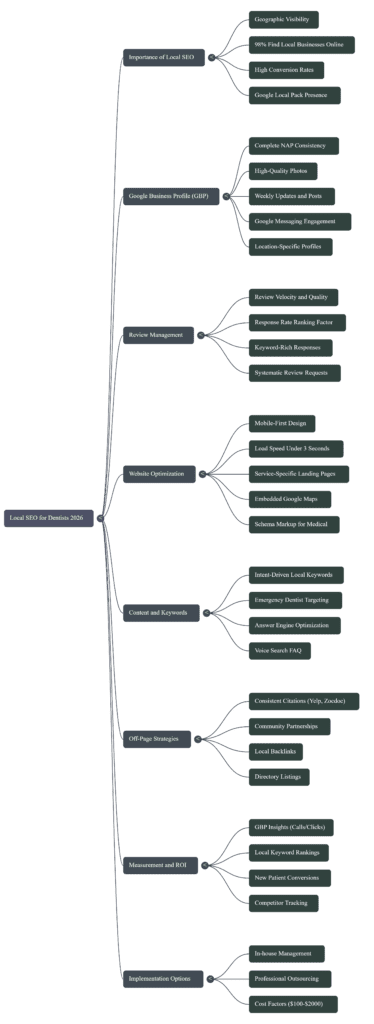
The importance of local SEO for dental practices
The goal of local SEO is to improve your online visibility in a specific geographic area, unlike general SEO, which targets national or global audiences. As a dentist, most of your patients are local – usually within a five to ten mile radius of your office.
Consider this:
- Local businesses are found online by 98% of people.
- Within 24 hours, 77% of local searches result in an offline purchase or appointment.
- 45% of Google searches are local – meaning they are looking for local services.
Your dental practice is likely missing out on the majority of potential patients actively searching for the services you provide if it doesn’t appear in the Google Local Pack (the top three map results) or on Google Maps.
The basics of local SEO for dental practices
First learn what is local SEO and how it works for dentists now:
What is local SEO for dentists?
A local SEO strategy for dentists works to improve a practice’s visibility in local search results, such as ‘pediatric dentist near me,’ so more patients can find the practice.
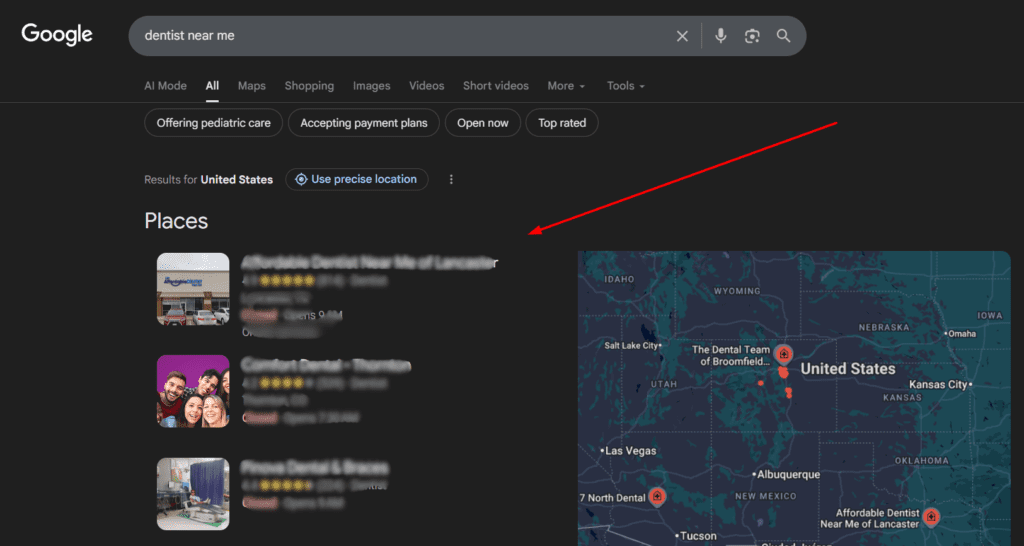
There are a number of strategies you can use to optimize local listings, create localized content, and more.
How can local SEO benefit dental practices?
There are several benefits to using local SEO as a dental practice, including the following:
How can local SEO benefit dental practices?
There are several benefits to using local SEO in a dental practice, including the following:
- People are constantly looking for solutions, whether it is finding the right dentist or finding gifts. You can increase the visibility of your practice by optimizing it for local search engines (SEO), so that people can find you and book an appointment online.
- Local SEO can also be used for promoting specialized services, such as teeth whitening, dental implants, or Botox. It can even be used to attract patients looking for practices that accept certain insurance plans.
- Local SEO enables people to find practices based on their location, needs, and preferences, such as dentists in Riverside, CA that accept Medicaid.
- A thriving practice can be created through local search engine optimization because it focuses on reaching the people who need your care – and aligns them with your ideal patients.
Getting started with local SEO for dentists
Learn how to start local SEO for dentists now!
What is the cost of local SEO for dentists?
Local SEO for dentists costs $100 to $2,000. Local search engine optimization costs depend on a number of factors, including the number of locations. Also, whether the SEO strategy is managed in-house or outsourced will determine how much it costs.
Your Google Business Profile is Your Digital Reception Desk
There are many dental practices that ignore their Google Business Profile (GBP) entirely – uploading basic contact information and saying they’re done. This fundamental mistake costs them thousands of potential patients every year.

Researchers have found that businesses with complete GMB profiles are 70% more likely to attract location visits from potential patients. However, most dental practices leave critical sections incomplete or outdated.
- Your services are explicitly listed with procedure-specific descriptions
- A high-quality photo of your office, team, and treatment results (with permission from the patient)
- Updates on dental health tips, services, and practice news every week
- Patient questions can be answered immediately through GBP messaging
If you have multiple locations, each location needs its own fully optimized GBP profile with location-specific content and keywords. Each office is treated as a separate entity by Google. The practice of ranking one “main” profile for multiple locations is a sure way to lose out to practices that understand the fundamentals of local search.
Optimize Your Google Business Profile (GBP).
Local SEO starts with your Google Business Profile (formerly Google My Business). Optimised properly, your website gives Google a complete picture of your practice, including your location, hours, services, and reviews.
Tips to optimize your GBP:
You must fill out every section: Your business name, address, phone number (NAP), website, and service areas must match exactly across all platforms.
A good example of a high-performing category would be “Dentist,” “Cosmetic Dentist,” and “Pediatric Dentist.”.
Increase engagement by adding high-quality photos of your office, team, and treatment areas.
Share updates, offers, or blog snippets weekly – it signals activity and helps with SEO.
Patients love convenience. Enabling Google Messaging can increase appointment requests.
With Rubilian’s Local SEO service, you can track how your GBP listing performs over time. You can also receive an alert if your competitors update theirs – giving you the edge.
Be Consistent with Citations and NAPs
Citations are references to your business on websites such as Yelp, Zocdoc, or the local Chamber of Commerce website. Each citation should contain the same Name, Address, and Phone number (NAP).

Even small inconsistencies can confuse Google’s algorithms.
Action checklist:
- Use Rubilian or a citation tool to audit your NAP consistency.
- Update listings on top healthcare directories.
- Make sure that phone numbers are not duplicated or mismatched.
- Make sure your practice is listed in local business directories and community health boards.
Your ranking is determined by the patient review algorithm
To determine your ranking on Google’s local search, it analyzes your review velocity, response rate, and content quality, not just your star rating.
Practices with an average rating of 4+ stars receive 3x more calls than lower-rated competitors, but ratings aren’t everything. Those practices that consistently generate fresh reviews and respond to all feedback professionally are favored by Google’s algorithm.

The Response Rate Ranking Factor: Practices with high ratings but poor response rates consistently outrank those with higher ratings but poor response rates. Google indexes and uses your review responses for local ranking, so they’re more than just customer service.
A systematic review is initiated within 48 hours of positive patient experiences, with a focus on satisfied patients who are most likely to leave detailed, helpful reviews.
Respond to patient reviews and encourage them
Review signals aren’t just for reputation – they’re also ranking signals. In the Local Pack, Google considers both the quantity and quality of your reviews.
Here’s how to manage them strategically:
You should ask every patient who is happy to provide a review. Include your Google review link in your check-out routine or send a quick text/email reminder.
Respond to all reviews, both positive and negative. Engaging reviewers and addressing concerns builds trust.
You can add keyword relevance to your responses by mentioning specific services (e.g., “Thank you for trusting us with your Invisalign treatment! “).
Intent-Driven Local Keywords That Work
Dental practices often target broad terms like “dental services” or “family dentist” without focusing on the high-converting searches that drive actual appointments.
Searches for “Emergency dentist near me” convert at 89% higher rates than general dental terms. However, most practices do not optimize for emergency-related keywords.
Location-Specific Opportunities:
- Pediatric dentist in [Your City]
- “Dental implants in [neighborhood]”
- In your area, contact a “[Treatment] specialist”
- “Dentist appointments on Saturday [city]”
Service-Specific Landing Pages: By creating pages for each major treatment, you can capture searches for specific procedures and provide patients with valuable educational information.
Optimizing for specific neighborhoods in your service area captures patients who are searching locally first. The most common search term for a dentist in Beacon Hill is “Beacon Hill dentist” rather than “Boston dentist.”.
Optimize Your Website for Local SEO
You should still focus on your website even if you rank well on Google Maps. There should be strong local signals on every page, both for search engines and for human readers.
Best practices for dental websites:
- Include1. Include your city and state in the page title
Example: “Aesthetic Dentist in New York, CO | Smile Dental.” - Add2. Add local keywords naturally to your content
Avoid keyword stuffing. Instead, mentioning neighborhoods or nearby landmarks conversationally. - Create3. Create dedicated service pages
SEO-optimized pages should be created for each service, from teeth whitening to implants. - Embed4. Embed a Google Map on your contact page
It helps with user experience and reinforces geographical relevance. - Ensure a fast5. Ensure a fast load speed and mobile optimization
Over 65% of dental searches come from mobile users.
Most dental websites fail at mobile-first healthcare
Through Google’s mobile-first indexing, your website’s mobile performance directly affects all search rankings for dental services, as 68% of patients research dental services on portable devices. However, most dental websites fail basic mobile usability tests.
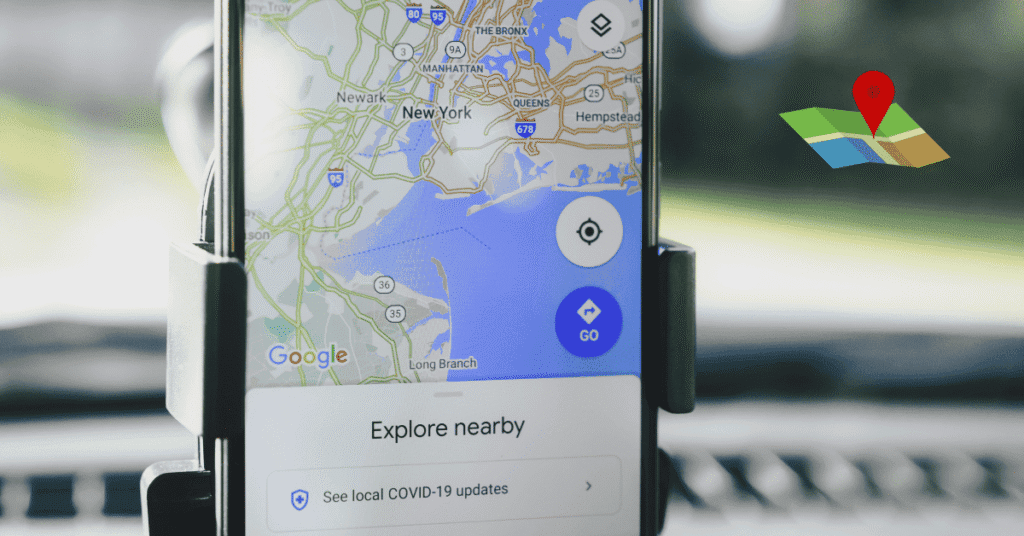
On average, dental websites take 7+ seconds to fully load on mobile devices, but pages that load in under 3 seconds have dramatically higher conversion rates. User experience isn’t the only issue here-your search rankings suffer as well.
Touch-Friendly Appointment Booking: Complex appointment forms with tiny input fields and multiple steps create barriers for mobile users. On smartphones, successful practices optimize for one-tap calling and simplified booking flows.
An emergency dentist near me at 11 PM requires prominent click-to-call functionality as well as clear emergency contact information. Inaccessible mobile sites lose emergency patients to competitors with more accessible designs that bury contact details or require navigation to find phone numbers.
Beyond Basic Optimization: Healthcare IT Technical SEO
Most general SEO services overlook additional technical considerations when optimizing dental websites. Search optimization for healthcare websites must be balanced with HIPAA compliance and medical advertising regulations.
Schema Markup for Medical Practices: By implementing structured data, search engines can better understand your services, location, and specialties.
Compliance and security: SSL certificates aren’t just for protecting patient data; they’re also ranking factors. Sites without proper security protocols receive lower search rankings regardless of the quality of their content.
You need a booking system that performs flawlessly. In addition to losing business immediately, technical issues that prevent patients from scheduling appointments signal to Google that your website provides a poor user experience.
Developing community partnerships and local backlinks
Google considers local backlinks a sign of activity and trust in your dental practice. A backlink is simply another website linking to yours – but quality and relevance are more important in local SEO.
Ways to earn local backlinks:
Donate to local schools or charities.
Partner with nearby health care providers (like pediatricians or orthodontics) to cross-link services.
Publish dental health articles in local blogs, newspapers, or community websites.
Get listed in the Chamber of Commerce directory in your city.
As a result of other local websites referencing your dental practice, search engines reinforce your position as an authority within that geographic area.
Enhance your content and Answer Engine Optimization
Patients often use voice search to locate local services – especially on mobile devices and smart speakers. Answer Engine optimization involves creating content that directly answers verbal questions.
For example,
Who is the best dentist near me for cosmetic dentistry?
How much does it cost to get a dental cleaning in [City]?
What’s the closest emergency dentist open now?
Create blog posts or FAQ sections that answer these types of questions in a conversational manner.
Featured snippets and voice search results benefit from structured content with question-based headings (“What causes tooth sensitivity?”).
Measuring What Matters
Vanity metrics dominate dental practices, but performance indicators that predict business growth are rarely tracked.
Local Search Performance Metrics:
- Keyword rankings based on location
- GBP insights: calls, directions, website clicks
- Local organic search traffic
- Digital channels for acquiring new patients
A new patient appointment generated from organic search is the ultimate measure of local SEO success. From the initial search to the appointment completion, practices should track the entire patient journey.
Keep track of your results, measure them, and adjust them
Local SEO is a long-term strategy that requires monitoring and improvement. Monitor the following metrics:
- Rankings for local keywords
- Location-based website traffic
- Your GBP clicks and calls
- Analyze trends and sentiment
- Conversion rates (appointments or phone calls)
Do-It-Yourself Dental SEO: The Reality
The implementation of comprehensive local SEO requires ongoing expertise in technical optimization, content strategy, review management, and algorithm updates. Dental practices lack internal resources as well as the specialized SEO knowledge they will need to compete effectively in 2026.
Practices that dominate local search work with specialized healthcare marketing teams that understand both search algorithms and dental industry regulations. It’s not just about optimizing websites; it’s about building complete digital patient acquisition systems.
Outsourcing local SEO for dentists
Learn how to outsource local SEO for dentists below:
What is the best time to outsource my dental practice’s local SEO marketing?
Consider outsourcing your dental practice’s local SEO marketing when:
- You don’t know enough about local SEO
- You don’t have time to practice local SEO
- Local SEO isn’t producing the results you expected
- You need to scale performance across multiple locations
If you hire a professional agency, contractor, or freelancer, your practice can improve its visibility in relevant search results – and attract new patients, giving you a boost to grow.
Grow your practice with local dental SEO
Well done! In this lesson, you learned how to use local search to attract more patients to your practice.
If you need help getting started with local SEO, Rubilian can help. With thousands of hours experience, we’re a trusted partner to dental practices worldwide.
The Final Thoughts: Building an Effective Local SEO Strategy for Dentists
For dentists, local SEO is more than ranking. It’s about connecting with your community. Maintaining consistent citations, earning positive reviews, optimizing your website for local and voice searches, and tracking results.
The end result of each local search represents someone who is in pain, in need, or ready to schedule a dental appointment. If they find your dental office quickly and trust what they see, you’ve already won half the battle.